Beyond Medical Slides: The Amedo Medical Presentation as a Versatile Professional Tool
In today's fast-paced professional landscape, the ability to communicate complex ideas with clarity, authority, and visual appeal is not just a skill—it’s a critical asset. While the name Amedo Medical Presentation might suggest a niche application, this sophisticated template represents a broader shift in how professionals across industries approach visual storytelling. It transcends its specific naming to become a versatile foundation for a wide array of projects, from corporate profiles and startup pitch decks to creative portfolios and personal showcases. This evolution speaks directly to changing needs in workflows, audience expectations, and the very nature of professional presentation itself.
The Core of Amedo: A Foundation Built for Precision and Flexibility
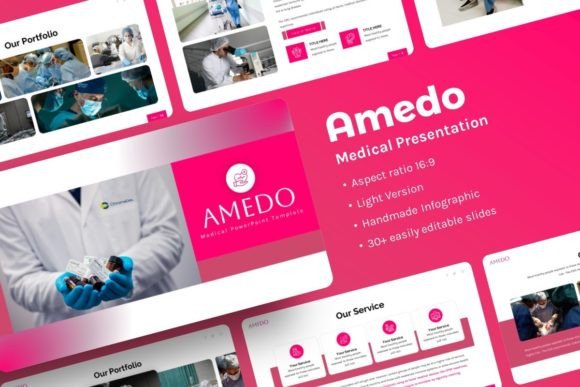
At its heart, the Amedo Medical Presentation is a meticulously crafted PowerPoint template system. Its initial design language likely caters to the exacting standards of medical and scientific communication, where data integrity, clear hierarchies, and accessible infographics are paramount. This foundation of precision is what makes it so powerfully adaptable. The template offers 30 unique slides, each serving as a building block. Rather than a rigid sequence, these slides constitute a library of components—title pages, content layouts, comparison frames, data visualization modules, and portfolio showcases—all based on a coherent master slide system. This ensures consistency while allowing for deep customization.
The technical features underscore this dual focus on structure and adaptability. Handcrafted infographics and pixel-perfect illustrations provide a starting point for authoritative content. Crucially, all graphics are resizable and editable, freeing the user from the constraints of pre-set imagery. The inclusion of picture placeholder functionality, allowing for drag-and-drop insertion, aligns perfectly with modern workflow demands for speed and efficiency. Supported by a comprehensive package including the .PPTX file, documentation, and a curated selection of fonts (Raleway, Karla) and image resources (Unsplash, Pixabay, Pexels), the Amedo Medical Presentation is designed not as a static product, but as a dynamic starting point.
Why Versatility is the New Professional Standard
The broad applicability of a template like Amedo Medical Presentation—envisioned for creative agencies, company profiles, corporate business, portfolios, photography, pitch decks, startups, and personal use—is not an accident. It reflects a convergence of several enduring trends in professional communication.
The Blurring of Professional Boundaries
Today’s entrepreneur might also be a content creator. A marketer needs to present data with the authority of a scientist. A freelancer’s personal portfolio must convey corporate-level polish. The silos between "medical," "business," and "creative" presentations are dissolving. Audiences, whether they are investors, clients, or peers, now expect a uniformly high standard of design and coherence, regardless of the industry. A template that originates from a field requiring rigorous clarity inherently carries that discipline into other domains, elevating the perceived credibility of any presentation.
The Demand for Integrated Toolkits
Professionals are increasingly resistant to fragmented workflows. Using one template for a client pitch, another for an internal report, and a third for a portfolio is inefficient and can dilute brand identity. The changing preference is for a single, robust toolkit that can be adapted to multiple needs. The Amedo Medical Presentation answers this by providing a unified visual language. Its master slide basis ensures that a startup’s pitch deck and its subsequent company profile maintain a consistent look and feel, building a stronger, more recognizable professional identity.
Data-Driven Storytelling Across Fields
The importance of data visualization has exploded beyond STEM fields. Creatives need to present project metrics, marketers analyze campaign ROI, and startups must track user growth. The handcrafted infographics and structured data slide options within this template provide the tools to tell stories with numbers in a compelling, easy-to-digest manner. This moves presentations from being subjective narratives to evidence-based arguments, a expectation in nearly all professional scenarios today.
Practical Applications: The Template in Action
Concrete examples illuminate how the Amedo Medical Presentation’s features meet real-world needs. Consider a design agency using it. They can employ the clean title slides and content layouts for a client proposal, utilize the comparison slides to showcase "before and after" design work, and leverage the portfolio-focused slides with drag-and-drop picture placeholders to create a stunning visual case study. The resizable illustrations can be tailored to match the agency’s brand colors, transforming the medical-themed graphics into custom artistic elements.
For a tech startup founder, the template’s inherent structure is a guardrail against chaotic pitch decks. The master slides enforce a logical flow. The infographic slides become perfect for illustrating user funnel analytics or market size data. The professional aesthetic immediately positions the startup as serious and trustworthy, often a challenge when using overly creative or informal templates. Meanwhile, a freelance photographer can strip away the more data-centric slides, focusing on the layouts with large image placeholders to build a minimalist, impactful online portfolio presentation, all while maintaining the sophisticated typography (Raleway, Karla) that comes bundled.
These adaptations are seamless because the template is built on easy customizable contents. The power lies not in the demo images (which are for preview only), but in the underlying, editable architecture. This shifts the value from what the template *is* to what the professional can *make it become*.
Connecting to Larger Developments in Design and Technology
The relevance of adaptable templates like this mirrors larger developments in software and design thinking. The move towards modular, component-based systems (seen in web design with UI libraries) is now reaching presentation tools. Users no longer want to build from a blank slate every time; they want to assemble from high-quality, interoperable parts. Furthermore, the emphasis on picture placeholder and drag-drop functionality acknowledges the cloud-based, asset-heavy workflows of modern creators, where images and graphics are constantly sourced from online libraries like Unsplash or Pexels.
It also connects to the democratization of high-end design. Access to polished, professional templates allows individuals and small teams to produce work that competes with outputs from large organizations with dedicated design departments. This levels the playing field and puts the emphasis back on the quality of the content and the idea, rather than the limitations of design skill or resources.
Forward-Looking Without Speculation: The Enduring Need for Clarity
Looking ahead, the core principles embedded in the Amedo Medical Presentation—clarity, consistency, evidence-based visualization, and adaptable structure—are likely to become even more critical. As information overload increases, the ability to distill and present complex material effectively will be a defining competitive advantage. Whether the content is medical research, a business strategy, a creative portfolio, or a personal achievement, the vessel that carries that information must be designed for comprehension and impact. This template, by virtue of its origins and construction, provides that vessel in a multifunctional form.
Ultimately, the attention paid to such a tool is about more than slides. It is about recognizing that professional communication is a holistic practice. The Amedo Medical Presentation template serves as a practical response to this reality, offering a single, powerful resource that empowers professionals, creators, entrepreneurs, and freelancers to build their stories with authority, flexibility, and a design sensibility that meets the elevated expectations of the contemporary audience. It is a testament to the idea that the best tools are those that provide a strong foundation, then step back and let the user’s unique content and vision take center stage.